10 Office Desk Drawer Organizer Tips for Global Buyers

A well-designed Office Desk Drawer Organizer can turn a crowded workstation into a more dependable daily tool. For global buyers, the choice involves more than appearance. Drawer width, internal height, material quality, packaging, and supplier consistency all affect purchasing results. A bamboo tray may suit a warm office, while recycled plastic can offer easier cleaning and stable pricing. Small details matter.

Measure twice.

This guide presents ten practical tips for evaluating drawer organizers across different markets. It considers modular layouts, pen compartments, cable storage, non-slip surfaces, and easy-to-clean finishes. Buyers should also request accurate product dimensions, clear photographs, sample units, and packaging details before placing larger orders. A supplier’s response time can reveal useful information about reliability, although it should not replace quality inspection. I have found that attractive samples sometimes hide weak joints or uneven edges. That possibility deserves attention.

Not every organizer suits every workplace. Some drawers need shallow compartments for clips and cards, while others require deeper sections for chargers or notebooks. Local office habits, climate, shipping conditions, and customer expectations may also influence the best choice. Sustainable claims should be supported by specific material information, not vague marketing language. Product descriptions must remain accurate and easy to verify. These tips help international buyers compare options carefully, reduce avoidable purchasing mistakes, and build a more practical desk storage program. A perfect solution is unlikely, but a tested and well-documented one can perform consistently.
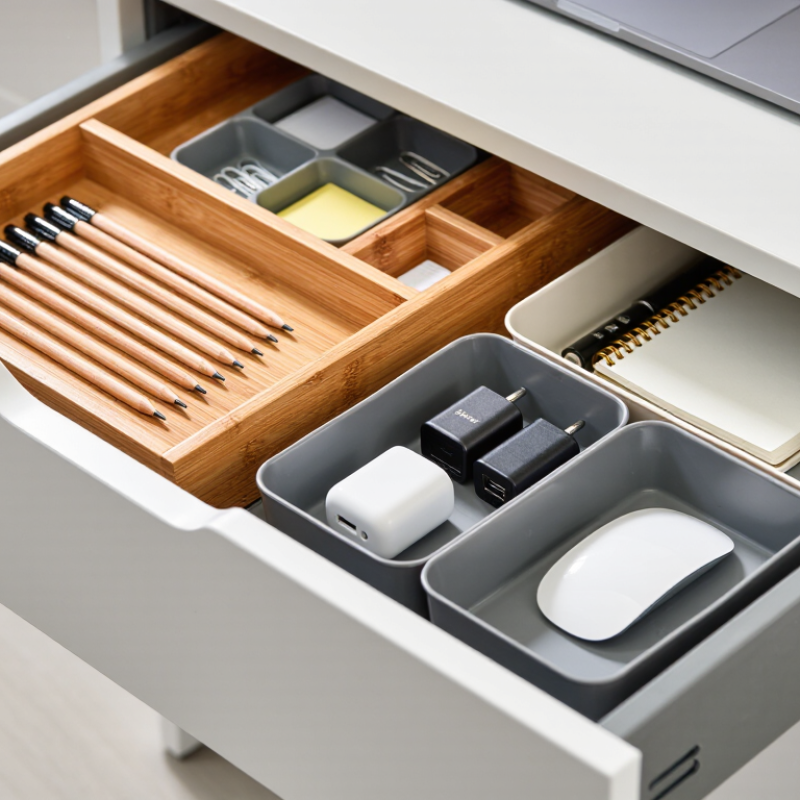
10 Office Desk Drawer Organizer Tips for Global Buyers

Define Office Desk Drawer Organizer Types and Their Uses

An office desk drawer organizer is not one universal product. Its type should match the objects stored inside. Shallow tray organizers suit pens, clips, sticky notes, and USB drives. They keep daily tools visible without wasting vertical space. Deep compartment organizers hold scissors, staplers, tape, and small notebooks. Small tools belong together. A divided tray also reduces searching time during busy work.

Adjustable-divider organizers work well for shared offices and changing storage needs. Buyers can move the dividers when supplies change. A vertical file insert stores documents, envelopes, and folders inside deeper drawers. It prevents papers from collapsing into a messy stack. Cable compartments are useful for chargers, adapters, and short cables. However, they need enough depth to avoid bending connectors sharply.

Material and construction affect long-term use. Plastic trays are light, moisture-resistant, and easy to clean. Metal organizers often provide stronger walls but may add drawer weight. Bamboo or wood options offer a warmer appearance, yet they need careful finishing around damp areas. Check drawer length, width, height, and rail clearance before ordering. Measure twice. A few millimeters can prevent smooth closing. For global purchasing, request material details, dimensional tolerances, load guidance, and sample inspection photos. I have seen attractive organizers fail because their corners caught on drawer rails. Rounded edges, stable bases, and non-slip feet usually improve daily handling, though these features can reduce usable space. That trade-off deserves a practical test, not just a catalog review.


10 Office Desk Drawer Organizer Tips for Global Buyers

Organizer Types and Their Primary Uses

The chart compares ten practical office desk drawer organizer types by the number of common item groups they can support. The item groups include writing tools, paper, cables, stationery, documents, and personal accessories. Global buyers should match the organizer type to drawer depth, item size, required flexibility, and the local paper format, such as A4 or Letter.

Tip: Choose modular dividers for changing storage needs, dedicated pen trays for frequently used writing tools, and document compartments only when the drawer is deep and wide enough for flat paper storage.

Assess Drawer Dimensions, Capacity, and Available Workspace

10 Office Desk Drawer Organizer Tips for Global Buyers

Assess Drawer Dimensions, Capacity, and Available Workspace

Measure the drawer’s internal length, width, and height before choosing an organizer. External measurements can mislead because rails and corner curves reduce usable space. Record each dimension in millimeters, especially when comparing products from different markets.

Check the drawer’s opening clearance too. A tall tray may fit inside but block the drawer from closing. Leave a small gap around the organizer for smooth movement. For deep drawers, stackable sections can separate stationery, cables, documents, and personal items. However, stacking may hide smaller tools. Keep frequently used items near the front.

Capacity deserves careful attention. Estimate the number of pens, clips, notebooks, chargers, and other daily supplies. Then choose compartments with slightly more room than your current needs. Overfilling creates pressure and makes retrieval slower. It also reduces the organizer’s practical lifespan.

Measure twice.

Available workspace matters beyond the drawer. A desktop with limited room may need a compact drawer system rather than a large external tray. Consider chair movement, leg clearance, and access to nearby equipment. My first arrangement looked tidy but left no space for a keyboard cable. That was a useful failure. Review the layout while seated, not only from above. Modular compartments can help, though they sometimes shift during daily use. Non-slip bases improve stability, but they may reduce usable height. Check both before ordering.

Choose Materials, Compartments, and Features for Daily Office Needs

10 Office Desk Drawer Organizer Tips for Global Buyers

Material choice shapes daily comfort. Powder-coated steel handles frequent use and resists surface scratches. Bamboo adds warmth, but it needs a dry environment and careful cleaning. Recycled plastic is lightweight and often easier to ship. Check for smooth edges, stable joints, and odor-free surfaces. I once selected a beautiful organizer with weak dividers. It looked efficient, but pens rolled underneath. That mistake changed how I assess construction.

Tip: Match compartments to actual supplies, not imagined habits. Measure the drawer before ordering, including its internal height. Create sections for pens, clips, cards, chargers, and notebooks. Adjustable dividers help different users, while fixed compartments may feel more stable. Leave one open space for unfamiliar tools. Offices change.

Features should support quiet, repeated movements.

Non-slip feet reduce sliding when the drawer opens quickly. Rounded corners protect hands and prevent fabric snags.

A removable tray makes cleaning easier, especially in shared workspaces. Cable openings can control charging wires, but oversized openings may look untidy.

For international purchasing, confirm dimensions, packaging protection, and cleaning instructions. Product measurements are sometimes rounded, so allow a small tolerance.

Tip: Test the layout with real stationery before placing a large order. A simple paper mock-up can reveal wasted space and awkward reaches.

Compare Suppliers, Quality Standards, Pricing, and Global Shipping Options

10 Office Desk Drawer Organizer Tips for Global Buyers

Compare Suppliers, Quality Standards, Pricing, and Global Shipping Options

For global buyers, a desk drawer organizer is more than a small plastic item. Supplier comparison should begin with measurable details: material, dimensions, wall thickness, weight capacity, and production tolerance. Ask for a pre-production sample, not only catalog photos. In factory reviews, I check whether dividers fit tightly and whether drawers open without scraping. Small defects become expensive across 5,000 units. Keep written records. They protect decisions when quotations change.

Quality standards need practical evidence. Request material declarations, inspection reports, and test results relevant to the destination market. Confirm recycled content claims independently. A stable supplier should explain sampling plans, acceptable defect levels, and corrective actions. I would also test odor, edge finishing, stacking strength, and carton compression. One missed check can damage a retail shipment. Plastic can look identical, but performance is not identical. My own process has failed before. I once focused on appearance and underestimated brittle corners during cold-weather transport. That mistake changed my checklist.

Compare total landed cost, not unit price alone. Include tooling, sample fees, packaging, inland delivery, freight, insurance, customs duties, and destination charges. Request separate quotes for ocean, rail, air, and consolidated freight. Confirm lead times, port pairs, carton dimensions, and agreed trade terms. Ask how delays are communicated. A cheap quote with weak cartons is not cheap. Build a small buffer. Global freight rarely follows the first schedule.

Check Product Safety, Packaging, Customization, and After-Sales Support

When sourcing office desk drawer organizers globally, product safety should guide every purchasing decision. Ask suppliers for material composition, load testing, and surface-finish reports. Check that plastics resist cracking and metal edges are smoothly finished. Small parts, sharp corners, and unpleasant odors can create avoidable workplace concerns. Requirements differ across markets, so confirm applicable standards with a qualified local specialist.

Tip 1: Request a pre-production sample. Place pens, scissors, clips, and a stapler inside it. Pull the drawer repeatedly and inspect movement, stability, and noise. A sample may look perfect but still reveal weak joints. I once underestimated drawer friction during evaluation; that mistake affected user comfort and packing dimensions.

Packaging needs equal attention. Each organizer should be protected from scratches, dust, and pressure damage. Use dividers, corner protection, and moisture-resistant materials when shipping by sea. Ask for carton drop-test evidence and clear outer labels. Overpackaging increases freight costs, but thin cartons create higher replacement rates.

Tip 2: Discuss customization in measurable terms. Confirm dimensions, colors, logo placement, material options, minimum order quantities, and sample approval procedures. Keep drawings and tolerances in writing. For after-sales support, agree on response times, spare-part availability, defect photos, and replacement policies before payment. Support promises sound reassuring, but written procedures are more dependable. Build a small inspection checklist for every shipment. It will not prevent every problem. It will expose weak assumptions earlier.

10 Office Desk Drawer Organizer Tips for Global Buyers - Check Product Safety, Packaging, Customization, and After-Sales Support

Tip Buyer Checkpoint Recommended Specification or Evidence Why It Matters Priority Suggested Supplier Question
1 Confirm material composition Request a full material declaration, such as PP, ABS, bamboo, steel, or recycled content. The material should match the product description and purchase documents. Accurate material information supports import documentation, recycling decisions, and regulatory review. High What materials are used in the tray, coating, feet, handles, and packaging?
2 Check product safety and chemical compliance For plastic or coated products, ask for current test reports or declarations covering applicable market requirements. Commonly reviewed substances include lead, cadmium, phthalates, and restricted chemicals under local rules. Safety requirements differ by destination, product material, and intended use. Evidence should be relevant to the actual product. High Can you provide a batch-linked test report for the exact material and finish?
3 Evaluate edges, corners, and moving parts Inspect for smooth edges, secure joints, stable dividers, and drawers that open without snagging. Ask for inspection photos or a pre-shipment sample. Desk organizers are frequently handled. Poor finishing can cause scratches, pinching points, or early breakage. High What quality-control points are used for sharp edges, cracks, loose parts, and drawer movement?
4 Verify load capacity and dimensional accuracy Compare external dimensions with the target drawer. Confirm internal compartment sizes, divider tolerances, and tested load capacity in kilograms. A few millimeters can determine whether an organizer fits a drawer. Load information helps prevent deformation during use. High What are the measured dimensions, acceptable tolerance, and maximum recommended load?
5 Review packaging protection Use suitable inner protection, corner protection where needed, moisture-resistant outer cartons, and packaging that prevents abrasion between units. Packaging directly affects breakage, surface damage, carton efficiency, and the final delivered condition. High What drop-test method, carton strength information, and packaging photos are available?
6 Calculate carton efficiency and shipping data Request carton length, width, height, gross weight, net weight, units per carton, and pallet information. Use the data to estimate transport volume. Accurate carton data improves freight quotations, warehouse planning, and landed-cost calculations. High Are the carton dimensions and weights based on a packed production sample?
7 Define customization limits before sampling Clarify available options for color, size, compartment layout, logo method, surface texture, inserts, and retail packaging. Separate standard options from tooling-based changes. Early confirmation reduces unexpected tooling charges, longer lead times, and design compromises. Medium Which changes require new tooling, what are the minimum order quantities, and what are the sample charges?
8 Confirm labeling and documentation Check whether carton marks, product labels, barcode placement, country-of-origin information, material symbols, and user instructions are required for the destination market. Correct labeling supports customs clearance, warehouse scanning, retail handling, and consumer information. High Can you follow our barcode artwork, carton-marking guide, and destination-market labeling requirements?
9 Set inspection and acceptance criteria Use an approved sample, written specifications, defect classifications, color tolerances, dimensional tolerances, and a pre-shipment inspection plan. Clear acceptance criteria make quality decisions measurable and reduce disputes after production. High Can the approved sample and inspection checklist be referenced in the purchase order?
10 Assess after-sales support Confirm the process for reporting shortages, transit damage, defects, replacement parts, corrective action, response times, and warranty terms. A documented support process protects the buyer when issues appear after delivery or during retail distribution. High What evidence is required for a claim, and how quickly will replacement or corrective-action decisions be made?
Buyer reminder: Requirements should be confirmed against the destination country, product materials, intended use, and current import regulations before placing a purchase order.